Archive for April, 2010

Getting Kids Into Gardening by Ruth Rogers Clausen

Thursday, April 22nd, 2010

Children and gardening go together naturally, but too few kids experience the fun of getting down into the dirt.  Try these projects to get them interested and don’t forget kids garden gloves to protect their hands.

What sounds like more fun to a child than growing garbage on a windowsill?  For a “Garbage Garden” start with carrots and pineapples, potatoes, and other vegetable waste bound for the garbage pail. It’s educational and cheap too. There’s no need for pots either. You just recycle cottage cheese or yogurt containers (poke drainage holes in the bottom).

To start your garden cut ¾” or so off the top of the round end of a carrot. Press the cut end into a container of damp potting soil, and put it on a sunny windowsill. Keep the soil moist, and a green forest will soon start to sprout. Cut leafy pineapple tops (wear gardening gloves to protect from prickles) with only ¼” of the pineapple left on. Clean away any flesh and let it dry overnight. Firm the top into a few inches of damp potting soil. Keep it moist and in several weeks— voila!  Roots.  

Garbage Gardening with a Potato

White potatoes grow quickly. Look for old ones with nubbins of developing shoots (called eyes). Cut a potato in half, each with 1 or 2 eyes, let it dry overnight, then plant it cut side down. Keep moist and you’ll have an indoor garden in no time. 

A good way to introduce older children to vegetables is with the Vegetable Garden Wheel. It helps them identify different popular vegetables and gives them the information they need to plan out a complete garden. The information is presented in a fun to use spinning format with lots of color.

Vegetable Garden Wheel

Potato after just 3 weeks

Greenhouses Come in all Shapes and Sizes

Monday, April 12th, 2010

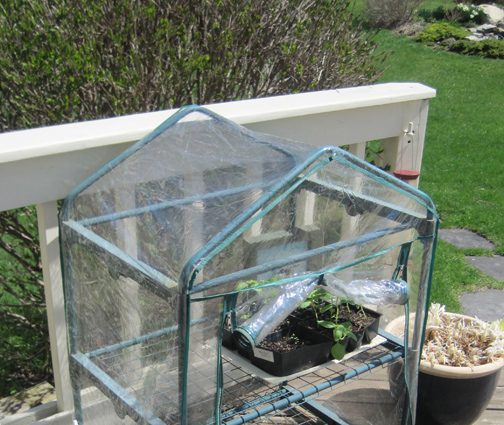
Mom's Greenhouse

Our greenhouse is moving along slowly, thank you very much. In the meantime, I have noticed that greenhouses come in all shapes and sizes.  For instance, my mother has a “greenhouse” of the type I would put in quotation marks. She lives 35 miles north of me in Sharon, CT.  This morning we visited a couple of garden centers in her neighborhood and presented the Womanswork line of garden gloves, then we went to her house for lunch. This is her “greenhouse.” It was purchased by mail through one of my favorite gardening companies, Lee Valley, and it consists of a lightweight metal frame with 2 shelves,  covered in clear plastic with a zippered window for entry. She puts her seedlings in there during the day, while the sun is shining , but she brings in her trays at night since temperatures are still low in northwestern Connecticut. In fact tonight they are predicting a frost in her area.

Another type of “greenhouse” is the window extension. You can have this built onto an existing window. It offers sun from the top and 3 sides and is very useful for a few seedlings and potted houseplants.

The next level up in greenhouses is the free standing greenhouse kit such as the one shown below. These greenhouses are often sold as “do-it-yourselfers” and are situated in an area of the yard where they can get full sun.

Finally, there is the type that is part greenhouse and part sunroom. Although our greenhouse will not be ornate like the ones shown here, it is more along the lines of these greenhouses because it is being designed to fit the architecture of  the house. In winter it will get full sun but in summer a large oak tree will shade it so it won’t need as much ventilation and cooling as most free standing greenhouses do.

The Conservatory Greenhouse

Free Standing Greenhouse from a Kit

Window ExtensionGreenhouse and Sunroom

Greenhouse and Sunroom

Garden Mystery Book & Garden Glove Give Away!

Sunday, April 11th, 2010

Garden Mystery Give Away

We have two paperback copies of Rosemary Harris’ Pushing Up Daisies to give away, along with a pair of Womanswork nitrile weeding gloves. Pushing Up Daisies is Rosemary’s first novel, and it won her the “Anthony and Agatha” nomination for best first novel. This week she launches her third book, Dead Head, published by St. Martin’s Minotaur imprint. I read it this weekend and it is as much fun as the first two were. Her books fit into the category of cozy mysteries. I found this definition at suite101.com. “Cozies are the kind of stories one might read while curled up on the couch with a cup of tea.”  There’s no gore or gratuitous violence.

The main character in Rosemary Harris’ ”Dirty Business” series is Paula Holliday, a cheeky 40-something woman, newly single and launching a landscaping business in a small town in Connecticut after being downsized from her big city career in video production. It turns out she has a knack for getting to the bottom of things, and finds herself at the center of a whodunnit in every plotline. Her landscaping business figures in her stories, which makes it a bonus for gardeners to read.

Rosemary Harris' Third Garden Mystery

I met Rosemary Harris for coffee at The Lakeside Diner (aka Paradise Diner). Read her books to find out the significance of that! I was impressed by the fact that she wears two hats. She is not only a writer, which is impressive enough, but she is a businesswoman. These days, you have to be willing and able to think like a marketing person because most publishers have limited resources for that. I commented that her lead character reminds me of  a Womanswork woman. She’s independent minded, a hard worker and likes to garden. That’s why we decided to cross promote Rosemary’s books with Womanswork gloves. We hope to work with the publisher in the future to do more.
Write a comment and we will do a random drawing for the books and gloves around this time next week. Let us know your glove size (size chart is here)

Pruning Shrubs–Not So Fast With the Silvery Shrubs, by Ruth Rogers Clausen

Thursday, April 1st, 2010

So spring is here and the summer and fall-blooming shrubs need to be pruned—right? Well, yes and no. Don’t be in a rush. Beware of pruning too early, especially those silver-leaved beauties that have only just started into growth.

Perovskia atriplicifoia

Through bitter experience, I have found that it is better to wait a couple of weeks until at least 1″ of new young growth is showing.  You can always cut back later, but too early pruning may indeed toll the bell for butterfly bush (Buddleia, shown here), common sage (Salvia officinalis), Russian sage (Perovskia), bluebeard (Caryopteris), lavender, etc.  A friend of mine living in the Delaware Valley had a crescent-shaped bed with a row of tall butterfly bushes running down the spine.  One spring, they were pruned hard just as the sap was rising and the buds were beginning to break. The following week there was an extended cold snap and every last butterfly bush was killed! It was a disaster and very hard lesson for her.

When I decide to prune these shrubs, I always wear sturdy and comfortable garden gloves to protect my hands, and am sure to use sharp hand pruners and loppers (www.felcostore.com). To encourage vigorous new growth, prune hard towards the base where new shoots are emerging.  Cut above a bud on a slant so rain runs off the  top of the cut. The harder you cut, the more vigorous the plants will grow. Every few years take the whole plant down to about a foot from ground level to increase vigor and control size.

Salvia officinalis